colors of the world
  • Home
  • Download
  • Social
  • Features
    • Lifestyle
    • Sports Group
      • Category 1
      • Category 2
      • Category 3
      • Category 4
      • Category 5
    • Sub Menu 3
    • Sub Menu 4
  • Contact Us
Kyoto lies 367 km West of Tokyo. Considering my status as a 'low-budget' traveler, perhaps it would be common to use the cheapest access as I could get. Well, yes, it happened for most of the time during my trip, but for my first inter-city journey (excluding the one between Sapporo and Tokyo, of course), I chose Tokaido Shinkansen instead of bus. Simply because I wanted to know how it feels to ride a super-fast train. If I went back to my country without ever experiencing the Shinkansen, what will the world say? *laugh*. Although it costed me some money, I would regret no more, right? *wink*.

So, that morning I checked out very early from the hostel, even the front office hadn't opened yet *grin*, and headed to Tokyo station. There was a liiitle incident with the ticket gate (and the station officer), but I finally could jump in at the last minute. Only few people were in the reserved wagon. From their suits, I could tell that most of them (if not all) were businessmen. Since it only took about 140 minutes by Nozomi train (also there are Hikari and Kodama trains) to reach Kyoto, they could easily attend the morning or afternoon meeting in Kyoto, then went back to Tokyo in the evening. Time efficiency matters a lot in Japan. 

I got the window seat on the right side. From one website, I read that the passenger sitting on the right side of the train heading to Kyoto from Tokyo (left side if it is from Kyoto to Tokyo) can see Mount Fuji in clear day. "Nice", I thought. I kept guessing every time I saw mountain-like shape. "That must be Mount Fuji", once I saw this mountain. Fuji is the highest mountain in Japan (3,776.24 m) and become the country symbol, depicted in art and photograph. 


Mount Fuji, don't you think?

The train itself was the form of luxury. Comfortable seats, wide leg space, clear and big window, side-head lamp, folding table to place your laptop, electric outlet, even wi-fi spoiled the passenger. (Almost) no shake, no sound as the train ran at its maximum speed of 300 km/h. 


My turn to show up ;)

The train arrived at Kyoto station at around 9 am. Since, I had to take another train to reach my lodging at Gion area, I directly went to the appropriate platform and waited there for about 30 minutes. 


Quiet morning at the station

The lodging, named IchiEnSou Guesthouse, was located on a small road near Gion-Shijo Station on the subway Keihan Line. An old man showed me where it is as there was only a small sign placed in front of its small gate. The owner, Yashi, was sitting on his desk right in front of the door, talking to his guests. He was expecting me since I had mentioned that I would come in the morning to put my bags. 

After a short rest while asking for advice, I decided to start from Kiyomizudera (Kiyomizu Temple) which could be reached by foot from the lodging. Phew, it happened to be pretty tiring to walk. Distance was bearable yet the heat was killing me. The signs directing to the temple was pretty clear. However, you need to pay attention as the temple area was connected only with two or three small roads from the main road. 

I took the first road and turned left, starting the felt-like-endless uphill ride. Then, I met an intersection and decided to go straight. "Gosh, I think I'm lost", when I saw a house-like building on the right and a small temple on the left, not an inch close to Kiyomizudera.


I decided to go straight at the intersection and got lost! :))

Ryoma Sakamoto
Better than directly turning back -while I had already climbed the hill- I paid for the entrance ticket at the temple area and climbed again! This time, it was stone stairs leading to a graveyard! It was the tomb of Ryoma Sakamoto (I recognized his picture hung at the ticket booth) and his troops (I suppose). Ryoma Sakamoto (1836-1867) was a leader of the movement to overthrow the Tokugawa shogunate during the Bakumatsu period in Japan. He played a crucial role which then brought about the Meiji Restoration. However, he couldn't see how Japan develop afterward as he was assassinated at age 31, not long before Meiji Restoration took place. Ryoma Sakamoto is honored as visionary who envisioned a Japan without any feudal trappings. In order to compete with industrially and technologically advanced outside world, the Japanese people need to modernize. Perhaps, without his contribution, there won't be modern Japan today.  


Tomb of Ryoma Sakamoto (and friends)

The graveyard itself was happened to be a part of Ryozen Gokoku Jinja (jinja means shrine) which was not opened for public except for the graveyard. Considering some cost visitors had to pay, it wasn't well maintained. That was even the first time I saw graffiti, if not to say vandalism, in 2.5 years of my life in Japan. Kinda surprised. Some small shops were also closed and its rolling doors became a place to put advertisement. But, if you see from the other side, there was always something good to offer: Kyoto from above. 


Not well-maintained. Too bad.

Kyoto, the city of history

Before continuing the trip to Kiyomizudera, I stepped into Kodai-ji, a temple which was located on the left-side of the intersection, also right across the street leading to Kiyomizudera. The temple was established in 1606 by Kita-no-Mandokoro (also known as Nene) in memory of her late husband Toyotomi Hideyoshi. A beautiful garden lies inside the temple area, one of the finest garden of its period. The garden was designated by the Japanese Government as "Place of Historical Importance and Outstanding Scenery". Always love Japanese style garden..


Kodai-ji Temple


Bamboo forest on the way out from the temple

To reach Kiyomizudera, visitors had to walk through line of merchants selling various Kyoto-taste souvenirs. And believe me, they were all tempting *laugh*. I had to hold my shopping impulse or I would be broken in just a few days of my 11 days trip *grin*. As the sun was getting high, I decided to have a lunch in the area. I went into a restaurant serving tofu meal set and ordered cold tofu, instead of boiled one. The menu seemed to be local specialty since not just one restaurant were offering tofu meal set. The taste? Do not expect it to be flavory or you might got disappointed. It was only served with soy sauce (shoyu) as flavor enhancer so we could still experience the original taste of tofu. Although I was already familiar in eating raw tofu, it was my first time to eat raw tofu placed in a bowl of cold water (with ice), thus needed a small drain to 'catch' the tofu. 


Merchants along the street


Wooden buildings and bricks pathway brought old atmosphere back.

A~nd finally I found Kiyomizudera. Walking through Deva-gate, a three-storied pagoda and a bell tower welcomed all visitors to the temple, which was built in 778 (although most of the recent buildings were rebuilt in 1663, during restoration ordered by Tokugawa Iemitsu). With 300 yen, we could enter the Main Hall (Hondo) while admiring the green scenery beneath from its large veranda. Beneath? Right. Kiyomizudera was supported by tall pillars -assembled without using a single nail- which made this temple unique. 


The famous Kiyomizudera

The name Kiyomizu means clear water or pure water which was taken from a waterfall within the complex, the Otowa waterfall. Three channels of water -believed to have wish-granting powers- fell into a pond and visitors could catch and drink one of them from a ladle.  


Lining up to drink the sacred water from one of the three channels

In the temple complex, there was also Jishu Jinja, dedicated to god of love and 'good matches'. Famous among girls, seen from those who make their wish there *grin*. Not far from the torii (gate), we could find a pair of 'love stones' placed 6 meters apart. Lonely visitors can try to walk between with their eyes closed. Success in reaching the other stone implies in finding true love. Since I only knew this story from my Japanese roommate the night after I visited the shrine, I didn't try to walk with closed eyes *laugh*. No, no.. I think I wouldn't try it anyway.    


Jishu Shrine, for those seeking for true love

That day was such an exhausting day. I got a terrible headache because of the heat and the sweat. After having enough rest, I went out around the area to buy something for dinner and found a shop that sells macha! (Maybe I should mention here that I like macha a lot! Later I found out that Kyoto is famous for its macha.). From various macha powder, macha sweets, macha ice cream, cold macha until macha ice shave with lots of topping selection were available. I bought cold macha with ginger and LOVE it. Well, not bad to end the day. In fact, I bought another glass the day after for my dinner *grin*.   

On day 5, I had -what I called- a 'Temples and Gardens' trip in Kyoto, using a One-day Card. So, stay tune on this blog!


Lesson learned
> If it is your first time to ride a Shinkansen and you don't know the ticket system, I suggest you to buy it at the ticket desk, instead of using ticket machine. By this, you will certainly receive the correct tickets (two tickets), thus being avoided from having trouble with the station officer *tongue*.
> Backpack and sweat were not a good combination at all. In my case, it caused a terrible headache and nausea. It would be better if I let the sweat dry naturally by moving the bag to the front once in a while. Using an umbrella might also be a good idea (if you're not holding a camera all the time). 


Sources:
Tokyo-Kyoto distance
Shinkansen (1)
Shinkansen (2) 
Mount Fuji
Ryoma Sakamoto
Kodai-ji Temple
Kiyomizudera (1)
Kiyomizudera (2)

Read also:
#1
#2
#3
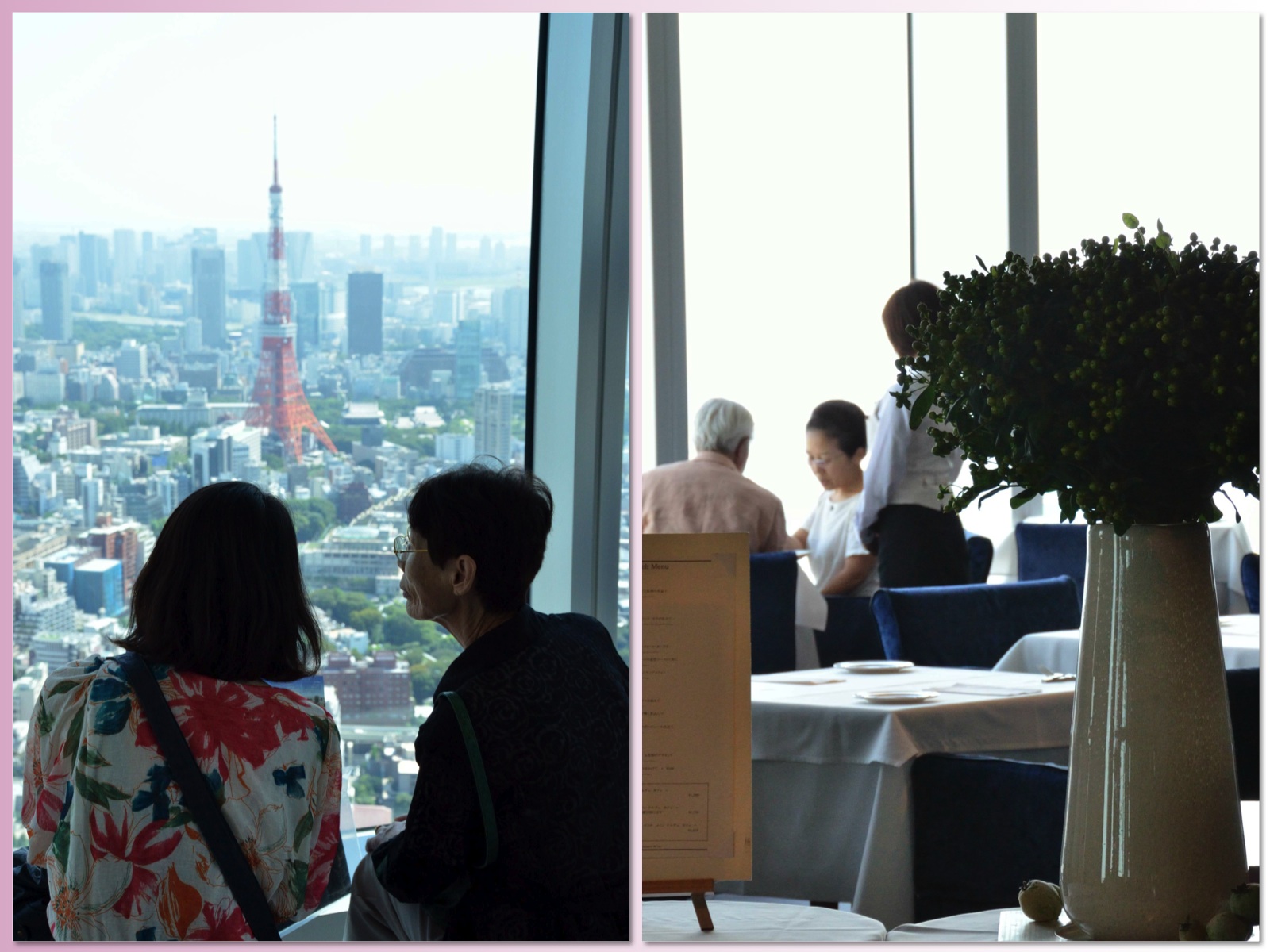
Third day was still in Tokyo. While planning my trip, I contacted my friends who live in Tokyo and finally we agreed to meet at Roppongi Hills, a business, shopping, and entertainment complex in Roppongi area. We decided to have lunch together, but before that, to fill my empty morning schedule, I wanted to visit somewhere around the area. As I searched on the map provided free by the hostel, I found Roppongi Tower, just inside Roppongi Hills complex. From its observation deck at 52nd floor, visitors can see the entire Tokyo from above, including the city symbol, Tokyo Tower. Thanks to the 360 degree glass window. But, I think it's even better than Tokyo Tower because they provided seats *grin*.

The megapolitan city and its green patches
Wish Jakarta has green area that large

Enjoying the morning from high above

Our meeting point was the odd spider statue in Roppongi Hills plaza. Why I say odd? The statue was black, huge and creepy. Plus its name was Maman. It became a funny joke for Indonesian since Maman is a traditional Sundanese (tribe from West Java) name for male and if we read it as Mamang (the creator was a French artist and Japanese also always read 'n' as 'ng' at the end of a word), it means 'uncle' in Sundanese. 


Happens to be an iconic meeting spot

Anyway, after the four of us met, we went straight to an Indonesian restaurant, Bali Cafe Putri, and order lunch set (which is cheeper than in usual hour *wink*). Besides the food, we were happy because the waiter and waitress were Indonesian. It was fun to speak Indonesian language to a stranger, even laugh together, just because he or she is also Indonesian. It seems to be true, when you are in foreign country, that sense of 'origin' becomes stronger, making a stranger into a fellow.


A warm reunion with lots of sweet stories, big laughters, and of course, delicious servings :)

A short meeting indeed, but I had to continue the journey. There was a lost scene when I was trying to find the nearest mosque to do my sholah and it didn't end nice (wish I had a GPS *sigh*). Because I had to arrive on time in Ghibli Museum, Mitaka, I turned back and decided to jump into a train heading to Mitaka. From Mitaka station in JR Chuo line, we could walk or took a bus (¥500 for round-trip ticket). Even the bus was painted Totoro.  


Tonari no Totoro (My Neighbor Totoro)
I was obsessed to visit Ghibli Museum after watching some of its production, such as Tonari no Totoro, Ponyo and Spirited Away. I had imagined that the place must be very intriguing. And it's true! The place brought you to a fantasy world in every single detail. Too bad, the visitors weren't allowed to take pictures. Instead, you can click on this link: http://www.ghibli-museum.jp/en/exibition/, which is the official site of the museum, to get an overall picture about what's inside. Oh, another thing is, every visitors were given a free ticket to watch original short movie at the theater, which was claimed to be the only theater in the world that has windows! 

Time sure flew quickly while I was still enjoying the magical atmosphere. Two hours weren't enough to explore the entire building, but the museum was about to close. If I have a chance to visit Tokyo again, I will make sure Ghibli Museum is in my list. 

Keep reading this series because the fourth day began with my first experience riding the bullet train, Shinkansen, to Kyoto. See you!


Extra: 
Tickets to the Ghibli Museum can only be purchased at Lawson (convenience store) through a ticket selling machine called Loppi, if you live in Japan. For international visitor, the tickets can be purchased through designated travel agencies. Further information is available at their official site.  


Source:
Tonari no Totoro (image)


Read also: 
#1
#2
[Better to read the previous post first ;D]
   

Nikko is a city in North of Tokyo which can be reached in 2 hours by train. Actually there are 2 options to go to Nikko by train. One is from Tobu Asakusa station, another is from JR Asakusa station. Just check the location, time, and price when you are planning to go to Nikko. You can get more information about Tobu lines here. It is more recommended than using JR after considering the time and cost (see wikitravel for more info). 

Snaphots on the way to Nikko

Three large shrines in Nikko which were already decided as world heritage sites (Toshogu Shrine, Futarasan Shrine, Rinnoji Temple) can be visited within one day tour (well, 4 hours were enough though) using a three-in-one pass (but you can buy separate ticket for each shrine if you want). By using World Heritage Ticket (sold at Tourist Information Center), you can reach the area by bus (about 10 minutes) from and to the station (round-trip ticket) for ¥500 (ask also for the nearest bus stop to the area entrance).

After buying the combination ticket for ¥1000, I was suggested to start the tour from a small garden near the ticket booth. The garden which surrounding a pond was very artistic, neat and so Japanese. Soothing and relaxing. 

.. and relaxing

Right across the gate of the garden, stood a huge storehouse-like building which wall was painted with large Buddha figure, not so convincing to be said as a temple (although in the end I assumed that the building must be under renovation or something). I came to think, "Hey, is that really the first site?". Then I saw a group of tourist in front of the stairs led to the building, listening to their guide's explanation about the building. I'm not lost then. Phew. 

Feeling assured, I climbed the stairs, showed my ticket, and entered the building. Oh yes, it WAS a temple, the Rinnoji Temple. Unfortunately we were not allowed to take photos inside. Shortly describe, a huge buddha statue sits in the middle of the building. 

Smaller statues are put inside a glass box, each of them represents special task. For visitor who wants to pray for certain thing, they have to insert a piece of coin (not sure how much, maybe the larger the nominal, the bigger chance your prayer comes true) into a wooden box in front of the God bearing the most appropriate task. Japanese prays by clapping their hands twice then bowing their head while saying their wish inside their heart. 

There was also a room, called Naki-ryu (crying dragon), which apparently built with a detail architecture in order to create an echo. When the priest stroke a wooden chime, we could hear a very soft, yet high-pitched sound, as if something (a dragon?) was crying (at least said to be so).  

The outside look of Rinnoji Temple should be like this

At shrines/temples you will always see booth selling o-mamori (charm), a small pocket with kanji embroidery. Japanese believes that inside o-mamori there is God who will protect them from bad deeds or who will give them good luck. People usually carry o-mamori and hang them on their bags at the day of exam or interview. You can read about common o-mamori purposes here.

O-mamori

Out from Rinnoji Temple, I went to the second one, Toshogu Shrine which was built a little up on a hill. It was the burial place of dynasty founder Tokugawa Ieyasu. Ieyasu was buried here immediately after his death, but the present complex was only built in 1634 in the order of his grandson, Iemitsu. Here we could see the famous story of three wise monkeys (sanzaru), who "hear no evil, see no evil, speak no evil", being carved on wood lining on the wall, below the roof the Sacred Stall, house of a white guardian horse. They are part of a curious series of carvings about the life cycle of a monkey, from giddy childhood to fearful old age. 

The famous sanzaru

I have to say, in my opinion, Toshogu Shrine somehow must be strongly influenced by Indian culture. You will understand what I mean, if you look at the very detail carving, the vibrant colors, the imaginative figures. But it happened to be a Shinto shrine. It was my first time visiting a shrine that ornamented, that fancy. Unlucky, the main building of the shrine was under renovation, so we couldn't see how it looks. Interesting that there was a corner displaying barrels along with a glass box enclosing bottles of Kirin beer. Kirin itself is an imaginative animal having a deer's body (hooves are divided into two parts), cow's tail and wolf's head with horn. I thought Kirin is just a brand. For that I know what it really is. 

Sophisticated carving richly decorating Yomei-mon (above) at Toshugu Shrine

Absolutely different atmosphere could be felt when I visited the third site, Futarasan Shrine. It represented typical Japanese shrine. Simple colors and lack of ornaments made this shrine lift serenity up into the air. The main room was spread out with tatami, Japanese mat, with no furniture on top of it. Again, very simple. 

Crossing the circle will bring good luck (believed to be so) - at Futarasan Shine

Actually, besides these three sites, there was another one, Taiyuinbyo, the mausoleum of the third Tokugawa shogun, Iemitsu, the grandson of Ieyasu. To reach the place, I had to climb more than 80 steps of stairs. Way up the hill. The architecture, the ornaments, the colors were very much alike Toshogu Shrine. Interesting because it was in separate location. There, visitors could give their honor to the shogun, his wife, and his first son (if I'm not mistaken, since the explanation was in Japanese *grin*). 

Compare it with Toshugu Shrine!

The journey ended when my tummy was already demanding its right. I stopped by a small restaurant serving Japanese cuisine. Since I'm a muslim, I carefully selected the menu and came up with a tempura set. Not forget to buy small souvenirs (and two boxes of castella *laugh*), I waited for the bus to bring me back to the station. 

A day full in Nikko was pretty exhausting and I had to restore my energy for the next day, meeting up with my friends who live in Tokyo and having a trip to Ghibli Museum in Mitaka. So, that's up for day 2! Sayonara!

The train stopped at a small station on my way to tokyo and there it was!
Arashi! Never been that close, haha.. Lovely treat to end the trip :).


Sources:
Nikko (1)
Nikko (2)
Nikko (3)
Rinnoji Temple (image)
O-mamori (image)


When you soon will leave one place and don't know whether you're able to go back again or not, you'll tend to cherish every last moments you have, just to make sure you have the best impression of that place. So in the future, you will feel content every time you recollect those memories. 

And that's the reason why I went for a graduation trip last September. Don't get it wrong, I love Hokkaido. The nature is indeed amazing. No doubt about it. However, since domestication of the Northern land by mainland Japanese (shoving the native Ainu) was relatively new, traces of ancient Japanese culture barely decorate the landscape of Hokkaido. "At least you have to visit Kyoto", my daily supervisor said, "If you want to see the famous Japanese culture". Okay then, Kyoto became one of the must-visited city in my trip. After searching and considering things, finally I decided to take this route: Sapporo-Tokyo-Kyoto-Nara-Osaka-Hiroshima-Osaka-Sapporo, all in 11 days of trip. 


Day 1

On September 5th, instead of direct flight to Tokyo, I took morning flight from Sapporo to Ibaraki and went to Tokyo by bus (buses from the airport are provided and it's free for passenger!). Why? Simple, it's cheaper *grin*. If you book early (and lucky), you can get as low as ¥5800! (Mine was ¥9800 though but it still saved some money). Although it definitely took longer time (1.5 hours flight plus 2.5 hours on bus), I would arrived in Tokyo at around the same time because direct flight to Haneda Airport Tokyo was about 1.5 hours after the flight to Ibaraki.

Skymark Airlines, famous for its low price

After a bit lost at Tokyo Station, I went ahead to the lodge near Inaricho Station on subway Ginza line, called Oak Hostel. It was my first time being a so-called backpacker and with limited budget, staying at a hostel or guest house seems to be a reasonable. Although there were also single rooms, lower price dormitory rooms was the best budget-friendly choice. Just pray to get cooperative roommates, at least they don't snore at night *laugh*. My two Swedish roommates were nice, thankfully *smile*. 

Overall the hostel was very nice. The room was quite big and air-conditioned, with a clean bathroom inside. They provided cable TV per room (which impressed me. you have cable TV in hotel room, but hostel?). There was also a small yet full equipped common kitchen, a coin washing machine, a common dining table and a relax sofa. Four computers with internet were free. What else can you expect? Oh yes, the most important thing, it's cheap! For dormitory rooms, I paid about ¥2900 per night. With all the facilities, it's worth the money. 

Because the hostel was not far from Asakusa area, using rented bike (though it was free for guest, ¥10.000 deposit was needed) I went to Kappabashi Dougu Street on my way to Kaminarimon. There you can find kitchenware shops along the street, also shops selling food samples for restaurant displays. You know, the one that looks like real (even seems more delicious than the actual food *laugh*). Japanese technique in making those fake food is amazing. They even can make 'floating' fork or chopstick as if the tools are being used to roll noodles, or bottle in 'laying' position with its liquid being poured to a cup or glass. 

Food samples as souvenirs

When I arrived at Kaminarimon, it was already pass 6 pm. Most of the stores were already closed. I managed to buy little gifts for my friends (and me *grin*), but mainly I took pictures of the shrine and the gate. Last year I went to Kaminarimon at noon and the place was packed with people, mostly tourist, of course. This time I could quietly took photos of the big red lantern with less people passing by.    

Shops long the road to the temple

Kaminarimon and Senso-ji (Asakusa Kannon Temple)

My first day in Tokyo ended as I went back to the lodge after grabbing something to eat for dinner, just a simple one from a nearby konbini (convenience store). Plan for day 2 was a trip Nikko, a city with world heritage shrine, near Tokyo. Got to rest then. See you!


Moral
I met an old man at the airport, seems to be the officer there, who ask me where my destination was. Because it was still couple of minutes until the bus arrive, I waited inside the building, instead of sitting outside (it was HOT fyi *laugh*). After a while, he came inside, looked for me, and when he saw me, he told me that the bus had arrived. Thanks to him, I didn't miss the bus. Such a dedicated public officer. 


Source:
Food samples (image)

   
Wow! It's already May! Means I haven't updated this blog for 5 months. Guess I need more consistency to post at least once a month. Don't you think?


In Japan, the famous sign of spring is cherry tree flower or sakura blossom. Okinawa at the south would be the first area to experience the blossom of sakura in late January every year, proceeded by the northern region up until Hokkaido where sakura blossoms in early May. 

Sakura blossom front move from south to north

It's very soothing to see a tree full of pink flowers. Delicately beautiful. I think that's also why Japanese people cherish this period very much. Moreover because it's only last for about 2 weeks until the flower's petal gone as it's blown by the wind. There's even 'sakura forecast' to monitor whether the flower has reached its full bloom state or not. Japanese pay close attention to this forecast, along with weather forecast of course, to hold a cherry-seeing party or hanami (花見), where 'hana' means flower (and it always refers to sakura)  and 'mi' means to see. People together with friends and family unfolded their picnic mat at parks, shrines, temples, bring out foods and drinks, even barbecue set and enjoy the pretty flower, relaxing atmosphere and warm weather. 

Hanami at Maruyama Park, Sapporo
with only one tree with flowers left


Our food that day

Since there is around 200 varieties of sakura tree and they don't bloom at the same time, you can still see a tinge of pink here and there in Sapporo, but the hanami season had already passed. Guess the standard is based on the most popular one somei yoshino or Prunus x yedoensis which has white to light-pink petals and usually will fall within a week or two. 

Somei yoshino
Remaining sakura

Another variety of sakura

Ume flower
It blooms at the same period with sakura and it also pink!

Since next year most likely I won't be at Japan anymore, I can say for sure that sakura blossom and hanami will be one thing (I mean two things) I miss from this country.


Link:
Cherry blossom front moves
   
Traditional Japanese new year decoration


It's been a while since my last post. A couple more days to new year and snow has turned into slippery ice here, in Sapporo. 


This new year will be my second in Japan. Back in my country, religious feasts are considered the most important time of the year, so we don't really celebrate New Year. Yes, there are events, like parties, fireworks, music concert, or just going out to the street with friends, making loud noises with paper trumpet or car horn. Recently religious alternatives such as self introspection and lecture are also held to welcome New Year. But those are not custom or tradition in the means that it is passed from generation to generation, you definitely do it every year, and has some meanings behind.  

That is why I was surprised when the end of the year approach last year. In Japan, New Year's Eve (Ōmisoka - 大晦日) and New Year's Day (o-Shougatsu - お正月) are considered the most important moments, many people go back to their hometown to gather with family, and celebrate it with traditions.


Ōsōji (大掃除)

'Sōji' means 'cleaning' and 'ō' means 'big'. Simply said 'big cleaning', and it really are. Before 31st December, people clean their house thoroughly, in and out, wipe here and there, brush the floors, reorganize things. Not only house, but also at work, school, and of course also at my lab. The purpose is to welcome new year in fresh, clean state. New year new spirit.

Nengajō (年賀状)


Sold at Rakuten

In today's digital era, does postcard still popular? In Japan, the answer is yes. People send New Year postcards (nengajō) to friends and relatives. My Japanese language teacher said, for the postcards to be able to arrive at destination address at 1st January, it has to be sent before a specific date mentioned by Japan Post (I admire the accuracy of time in Japan). New Year postcards can be bought at post office, convenience store, books and stationary store, or it can be self-printed with our own creativity. The design is various, but usually the cards have Chinese zodiac sign of the year as part of design. 2011 is year of rabbit, so this animal becomes the icon of 2011 New Year postcard. There are some greetings which are commonly written on the postcard (personal message can be added to if you want), such as:
  • (shinnen) akemashite o-medetō-gozaimasu ((新年)あけましておめでとうございます) (Happiness to you on the dawn [of a New Year])
  • kotoshi mo yoroshiku o-negai-shimasu (今年もよろしくお願いします) (I hope for your favour again in the coming year)
  • kinga shinnen (謹賀新年) (Happy New Year)
  • shoshun (初春) (literally "early spring")
What interesting is the postcard sold by post office has lottery number printed. On 15th January, the winners are picked and prizes are given to winning number holder. Guess, new year new luck?

Parties (bōnenkai 忘年会・shinnenkai 新年会)

Parties? A custom? Yup. Japanese hold parties before year end, called bōnenkai, literally means party to forget everything in the past year. I see it is a must event among co-workers and friends. You can have more than one bōnenkai on December, one with your co-workers, one with your international friends, one with your friends at Japanese language class, and more if you are a member in other communities. And, of course, each party costs money. Sigh. 

There is also shinnenkai, New Year party, although it is less popular than bōnenkai, thankfully. If not, I would say, new year empty pocket @_@.

Bell ringing

On first days of January this year, I watched on television about crowd of people visiting temples on New Year's Eve. Apparently, at midnight, when both arms of clock point at 12, Buddhist temples ring their bells 108 times to symbolize the 108 sins in Buddhist belief, and to get rid of the 108 worldly desires regarding sense and feeling in every Japanese people. New year new life (though I don't believe in such a thing, no offence).

O-toshidama (お年玉)

Last year, besides learning to make nengajō, we were given a small decorated envelope, called pochibukuro (ポチ袋). In New Year, Japanese people has custom to give money to children. I'm not sure about the amount, but if I'm not mistaken, it is about 10-20.000 yen per envelope. Maybe little children get 5.000 yen. So, for children, new year lots of income, haha..


See here for details

Food

Osechi-ryori
Japanese people eat special dish on special moment. On ōmisoka, people customarily eat buckwheat noodles, toshikosi soba (年越しそば), to wish for long life, associating eating long noodles with 'crossing over from this year to next year'. Referring to some sites, on o-shōtgatsu, people eat special selection of dishes, called osechi-ryōri (御節料理), presented in layer boxes, called jubako. Many are sweet, sour, or dried, so that they can keep without refrigeration and eat it for couple of first days on new year - when shops are close, thus allowing them to have cooking break. Some of the dishes are boiled seaweed (kombu 昆布), fish cakes (kamaboko 蒲鉾), mashed sweet potato with chestnut (kurikinton 栗きんとん), simmered burdock root (kinpira gobō 金平牛蒡), and sweetened black soybeans (kuromame 黒豆). Each has meaning, like kamaboko for pleasure and happiness, kurikinton for good wealth and fortune. New year with plenty of food. 

Mochi 

Kagami mochi
Couple days ago I went to an equipment store and there were stacks of boxes with two white round layer and an orange (daidai 橙) on top inside each box. Then I remembered about kagami mochi (鏡餅) thing. It is a New Year decoration made from mochi (餅), sticky rice. 

Making mochi is another custom in New Year. Boiled sticky rice (mochigome 餅米) is put into a wooden shallow bucket-like container and patted with water by one person while another person hits it with a large wooden mallet. By doing it repeatedly, it forms sticky pulp, then shaped into cakes or buns, usually stuffed with bean paste. But, maybe for kagami mochi, no bean paste, only plain mochi. 

Since mochi is food, likely those sold at the store were kagami mochi-shape plastic decoration, so it can be used again next year. Little surprised though. I didn't know they sell the plastic version. When tradition has to compromise with time and money.

'The Firsts'

Everything first happen in New Year is important for Japanese people. Hatsuhinode (初日の出) is the first sunrise of the year. Some catch the first rays from inside the grounds of shrine, others may prefer to drive to the coast or climb a mountain to see the first sunrise of the year. Hatsumōde is the first visit to shrine or temple, might be after midnight or during the day on 1st January. Other 'firsts' include shigoto-hajime (仕事始め, the first work of the new year), hatsu-uri (初売り, the first shopping sale of the year), hatsugama (the first tea ceremony of the year), keiko-hajime (稽古始め, the first practice of the year). New year with good first step.


Tomorrow winter break will start for the next one week. You can feel holiday atmosphere everywhere, of course also in my lab. Although I don't consider New Year as something really special, who can resist holiday? 


References:
new year
nengajo
osechi-ryori
osechi ryori (image)
traditional Japanese new year decoration (image)
kagami mochi (image)
Older Posts Home

ABOUT ME

I could look back at my life and get a good story out of it. It's a picture of somebody trying to figure things out.

POPULAR POSTS

  • Graduation trip series: #4 Ryoma Sakamoto, Kodai-ji and Kiyomizudera, Kyoto
  • Graduation trip series: #3 Roppongi Hills and Ghibli Museum, Tokyo
  • Find the next episodes in my future book!
  • Last sakura
  • from japan with love
  • Graduation trip series: #1 Asakusa, Tokyo
  • Graduation trip series: #2 Nikko
  • O-shougatsu: New year new hope
  • Jungle of strange characters
  • spoon-fork-knife-CHOPSTICKS

Categories

  • daily life
  • japan
  • moment
  • travel

Advertisement

Follow us on Facebook

Contact Form

Name

Email *

Message *

About Me


I could look back at my life and get a good story out of it. It's a picture of somebody trying to figure things out. Great things in business are never done by one person. They’re done by a team of people.

Popular Posts

  • Graduation trip series: #4 Ryoma Sakamoto, Kodai-ji and Kiyomizudera, Kyoto
  • Graduation trip series: #3 Roppongi Hills and Ghibli Museum, Tokyo
  • Find the next episodes in my future book!

Advertisement

Designed By OddThemes | Distributed By Blogger Templates